How to negotiate a medical bill
Negotiating a medical bill means asking the billing office to lower what you owe, or to let you pay it over time, once the charges themselves are right. This guide covers what to check before you ask, the four things a billing office can actually offer, and the words to use on the call.
Updated November 14, 2026 · 6 min read · 4 scripts you can copy
The short version
- Check the bill first. A discount on a bill with a mistake still leaves you paying for part of the mistake.
- Ask about financial assistance before you ask for a discount. It usually reduces a bill more.
- Then ask for a prompt-pay discount or an interest-free payment plan, by name.
- Get the new amount in writing before you pay.
In this guide
You can ask a hospital or doctor's office to lower a bill, and many will. But negotiating works best as the last step, not the first. If the bill has a mistake on it, you want the mistake removed, not a discount on the wrong number. So the order is: make sure the bill is right, see whether you qualify for help, and then ask for a lower price or more time.
Step 1: Check the bill before you negotiate it
A discount on a bill with an error in it still leaves you paying for part of the error. Before you ask for anything, get the itemized bill and, if you have insurance, your insurer's Explanation of Benefits (EOB) for the same visit.
While you check, call billing, say you're reviewing the charges, and ask them to note the account and hold it from collections. Don't pay anything toward a bill you're still questioning.
Step 2: Ask about financial assistance first
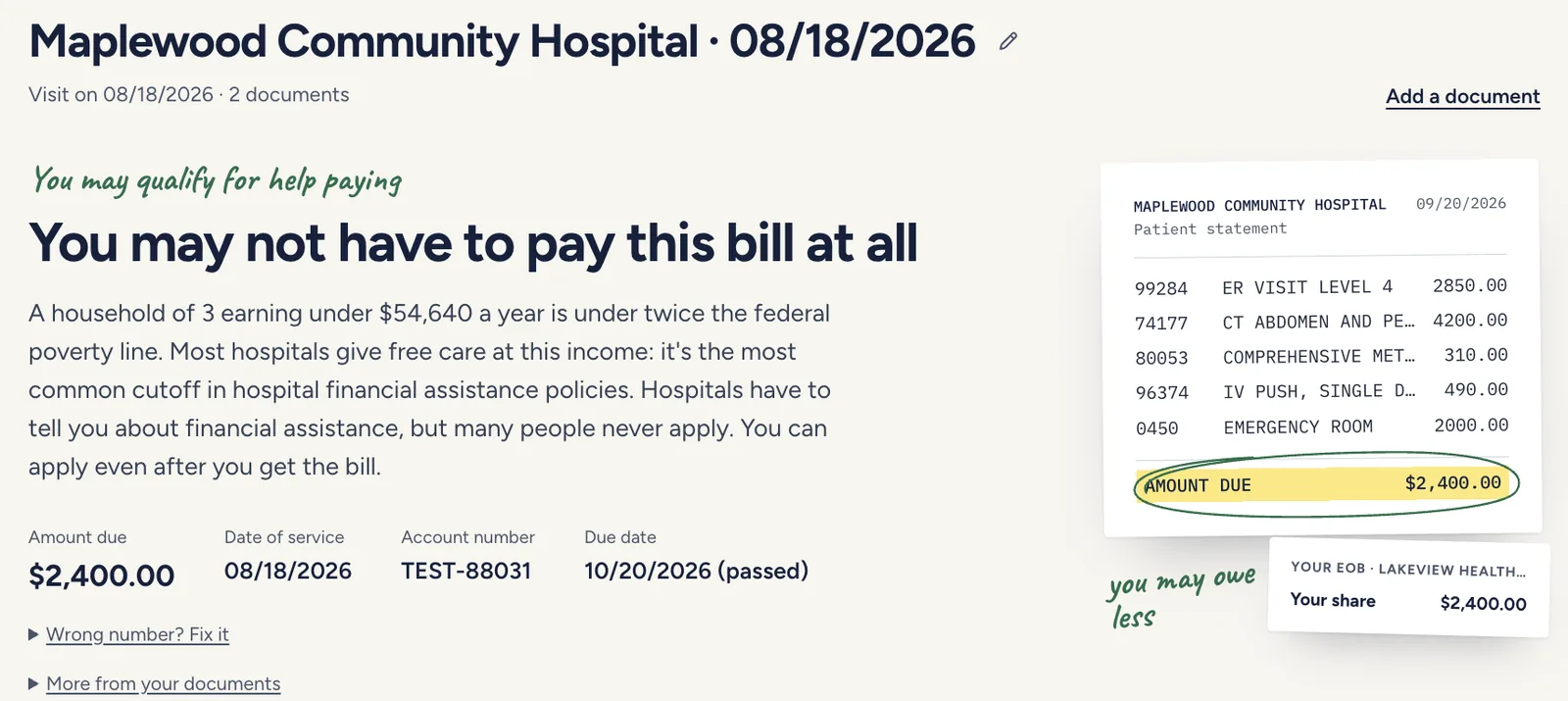
Nonprofit hospitals, which is most hospitals, have to have a written financial assistance policy, sometimes called charity care. Depending on your income and household size it can reduce a bill or erase it, and many policies cover people who have insurance. You can apply even after you've been billed: federal rules give you at least 240 days from the first bill.
Ask for this before you ask for a discount. If you qualify, the reduction is usually larger than anything a billing representative can offer on the phone, and a nonprofit hospital can't charge someone who qualifies more than it generally bills insured patients for the same care.
“Before I pay anything on account [number], I'd like to apply for financial assistance. Can you send me the application and your financial assistance policy, and hold the account from collections while my application is reviewed?”
Step 3: What can a billing office actually offer?
The person who answers the phone works from a short list. Knowing the list lets you ask for the right thing by name.
- A self-pay or uninsured discount. If you have no insurance, ask for the hospital's self-pay rate. Hospitals have to post their prices online, including the cash price, so you can look up what they say they charge people paying on their own.
- A prompt-pay discount. Many billing offices will take less if you pay the whole balance at once. Ask what the balance would be if you paid in full today, and get the answer in writing before you pay.
- An interest-free payment plan. If you can't pay at once, ask for monthly payments with no interest and no fees, at an amount you can keep up. A plan with the hospital is almost always better than a medical credit card.
- A hardship reduction. Outside the formal assistance policy, a supervisor or financial counselor can sometimes reduce a balance if you explain your situation. Ask who has the authority to do that.
Step 4: If you have insurance
With insurance, the price has already been negotiated once: your plan's allowed amount is lower than the hospital's list price, and your EOB shows it. What's left to negotiate is your share, the deductible, copay or coinsurance.
Some billing offices will discount your share for paying at once, or reduce it for hardship. Others will say their contract with your insurer doesn't allow it. Both happen, so ask. A payment plan and financial assistance are open to you either way.
Step 5: Make the call
Be specific and calm. Say what you can pay, ask what they can do, and let them answer. If the first person can't help, ask who can. Have the account number, the amount due and the date of service in front of you.
“Hi, I'm calling about account [number] for my visit on [date]. I've checked the bill and I want to take care of it, but I can't pay [amount due]. What discounts do you have for paying in full, and what would the balance be if I paid today? If you can't change it, who can I speak with who has the authority to?”
“I can't pay the full balance on account [number] at once. I can pay [amount] a month. Can you set up a payment plan at that amount with no interest and no fees, and send me the terms in writing? Please confirm the account won't go to collections while I'm paying on the plan.”
Step 6: Get it in writing before you pay
An agreement over the phone isn't a record. Before you give a card number, ask for the new amount or the plan terms in writing: a letter, an email, a message in the patient portal or an updated statement. Write down the date, the name of the person you spoke with and any reference number.
After you've paid a reduced amount in full, ask for a statement showing a zero balance, and keep it.
“Re: account [number], date of service [date]. On [date of call] I spoke with [name], who agreed to accept [amount] as payment in full for this account. Please confirm this in writing. I'll make the payment once I have your confirmation.”
If the bill is already in collections
You can negotiate with a collection agency too, but check the debt first. Within 30 days of a collector's first notice you can ask it in writing to prove the debt, and it has to stop collecting until it does. If the debt is right and you agree on a lower amount, get that agreement in writing before you pay, and keep proof of the payment.
What are the most common mistakes?
- Negotiating before checking. A discount on a bill with an error still leaves you paying for part of the error.
- Skipping financial assistance and going straight to asking for a discount.
- Paying on the phone before the new amount is in writing.
- Agreeing to a monthly payment you can't keep up. A missed plan payment can send the whole balance to collections.
- Putting the bill on a credit card or a medical credit card to make it go away. Once it's paid, the hospital has no reason to lower it, and deferred-interest cards can charge back-dated interest.
Questions people ask
Can you negotiate a medical bill after insurance has paid?
Yes, for your share of it. The total price was set by your plan's contract, but you can still ask for a prompt-pay discount, a payment plan or financial assistance on the part you owe. Some billing offices will reduce it and some won't, so ask.
How much will a hospital take off a bill?
It varies by hospital and by your situation, and no one can promise a number. Financial assistance usually gives the largest reductions. Ask what the balance would be if you paid in full, and get the answer in writing.
Does negotiating a medical bill hurt my credit?
No. Asking for a lower amount or a payment plan isn't reported anywhere. Only a debt that's been sent to a collector can show up on a credit report.
Should I pay someone to negotiate for me?
For most bills you can do this yourself with one or two calls. Paid services can help with very large or complicated bills, but many charge a percentage of what they save you, so ask how they're paid before you sign anything.
Educational information only, not legal, medical or financial advice. Rules vary by state and plan.