Can ChatGPT or Claude check your medical bill? What they get right, and what they miss
A general AI chatbot like ChatGPT or Claude can explain a medical bill and help you write to the billing office, but how good its advice is depends on what you ask it, and it can miss the errors and programs that would lower your bill. This guide covers what reporting in 2026 found when patients used chatbots to fight their bills, how to use one safely, and what a tool built only for checking bills should do differently.
Updated November 11, 2026 · 5 min read
The short version
- Chatbots explain jargon and draft letters well, but the advice depends on how you ask.
- They can sound sure without enough information, misread the law and skip financial assistance.
- Remove personal details, give it the itemized bill and EOB, and ask for the exact line behind every claim.
In this guide
More people are asking AI chatbots for help with medical bills. Sometimes it works. In April 2026, The New York Times reported on patients who used ChatGPT and Claude to challenge bills and insurance decisions. In one case, Claude's suggestions went into a letter, and the hospital waived a $22,604 emergency room bill. Others got advice that went nowhere.
Full disclosure: MedResolve AI uses the same kind of AI models. So this isn't an argument against AI. It's about what goes wrong when a general chatbot is asked to do a specialist's job, and how to avoid it, whichever tool you use.
What chatbots do well
- Translating jargon: what “allowed amount,” “coinsurance” or a code like CO-45 means.
- Explaining your rights in general terms, like surprise billing protections or the right to an itemized bill.
- Drafting a clear, polite letter or email to a billing office once you know what to ask for.
Where they fall short
The experts the Times spoke with, including legal aid lawyers and patient advocates, found the same kinds of problems again and again:
- The answer depends on how you ask. Getting useful help took knowing how to instruct the chatbot, or already knowing a lot about insurance. That puts the people who most need help at a disadvantage.
- They don't ask what they need to know. One patient was told to contact her state insurance commissioner, but her plan was self-funded by the city of Atlanta, and a state insurance department doesn't usually oversee self-funded plans. The chatbot never asked.
- They can sound sure without enough information. Another patient was told his plan had applied his benefits correctly, without the chatbot having what it needed to know that. It didn't suggest checking the bill for errors.
- They can misread the law. In the case that ended with the $22,604 bill waived, a legal aid director found that some of the rules the chatbot cited applied to insurers or debt collectors, not hospitals, and that it missed other options.
- They can skip financial assistance. The medical-bill podcast An Arm and a Leg, writing about the Times story, noted that chatbots often leave out charity care, the hospital programs that reduce or forgive bills for people under certain incomes. Jared Walker, who runs the charity care nonprofit Dollar For, told the Times that ChatGPT downplayed it when he asked it a hospital billing question.
As the man who wrote the letter that got the $22,604 bill waived put it, the chatbot was “a useful adviser, but not a perfect one.” He also stressed what no tool can do for you: keep following up until the bill is fixed.
What about privacy?
HIPAA, the federal health privacy law, covers doctors, hospitals and insurers. It doesn't cover chatbot companies. The Times noted that what you share with a chatbot doesn't have the legal protection of a conversation with your doctor, and can be requested in a lawsuit. Some chatbot makers now offer extra health-data protections, but they have to be switched on and aren't available to everyone.
How to use a chatbot safely on a medical bill
- Remove personal details first: your name, date of birth, Social Security number, member ID and account numbers.
- Give it the documents, not a summary: the itemized bill and your insurer's Explanation of Benefits (EOB) for the same visit. A description from memory leaves out the lines that matter.
- Ask it to point to the exact line for every problem it finds. If it can't, treat the claim as unconfirmed.
- Ask what it would need to know to be sure, then answer: whether you're insured, what kind of plan you have (through work, the Marketplace, Medicare or Medicaid), and your household size and income.
- Always ask about financial assistance separately: “Does this hospital have a charity care program, and would my income qualify?” Then check the hospital's own policy on its website.
- Check any law or rule it cites before you quote it to anyone. Ask for the name of the law and look it up.
- Get every fix in writing, and keep the name of everyone you talk to.
What a tool built only for medical bills should do
These are the standards we hold MedResolve AI to. They're also a fair checklist for any bill-checking tool you try:
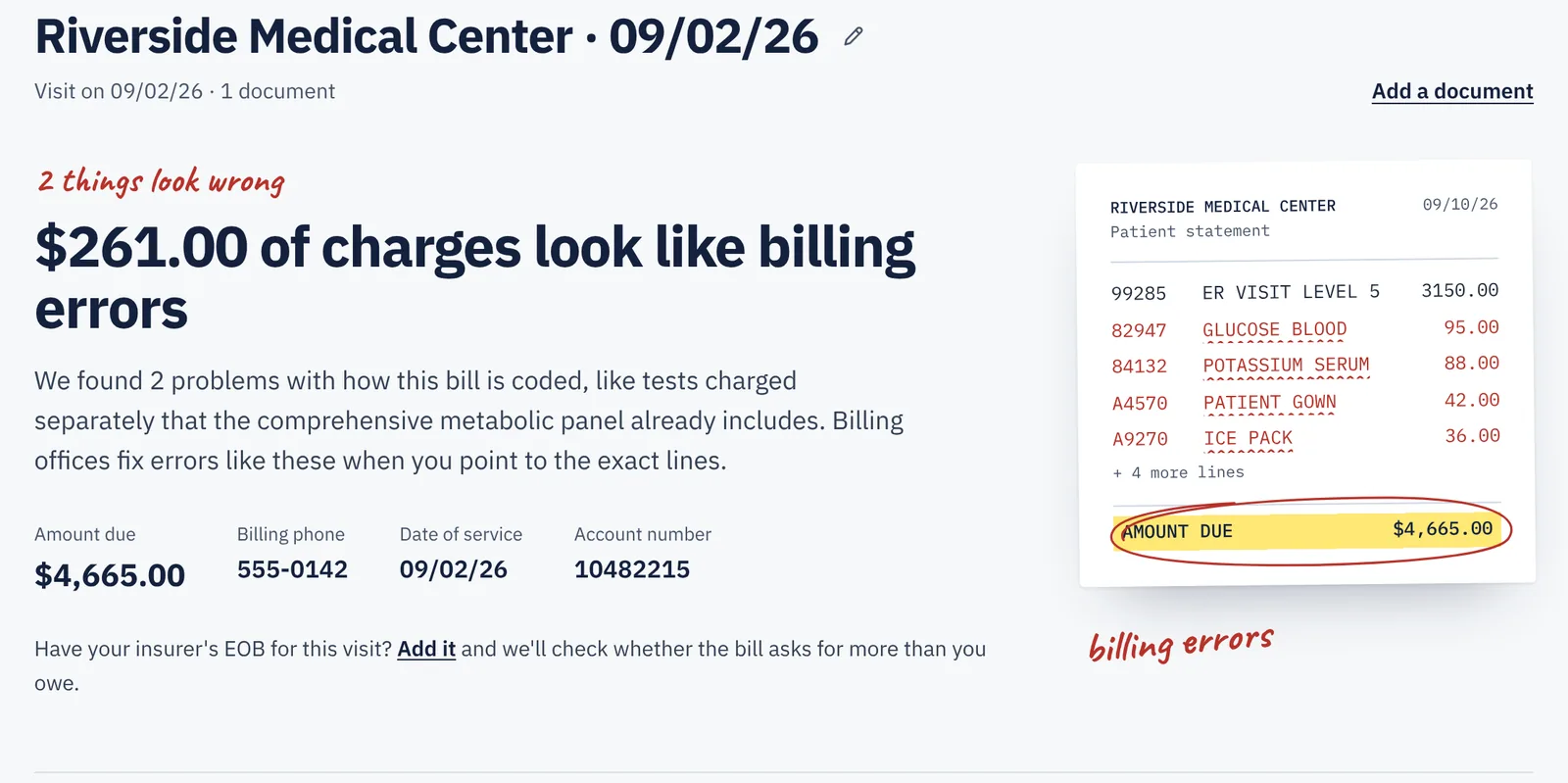
- Run the same checks on every bill, without depending on how you phrase a question: the bill's own math, repeated charges, tests billed on top of a panel that includes them, the bill against your EOB, surprise-billing protections, and prices compared with what Medicare pays.
- Check financial assistance every time, by asking for the few details it needs: whether you're insured, your household size and income.
- Point to the exact line on your bill behind every problem it raises.
- Have a second check. Every claim MedResolve makes is reviewed by a separate AI against your bill itself. Anything it can't confirm is taken out, and if that check can't run, you see only the basics until it can.
- Say when it isn't sure, instead of guessing. When we can't confirm something, we tell you what we left out and how to check it yourself.
- Be clear about privacy: what's kept, for how long, and who sees it. Ours is in plain English on our privacy page.
A bill checker finds the specific lines and programs worth asking about. The billing office makes the correction, so the call is short and you know exactly what to ask for.
Is it safe to upload my medical bill to ChatGPT?
Chatbot companies aren't covered by HIPAA, so remove your name, date of birth, Social Security number, member ID and account numbers first, and read the company's privacy settings for health information.
Can a chatbot negotiate my bill for me?
No. It can help you prepare and write what to say, but you still have to call or write to the billing office yourself, and follow up until the change is made.
Is MedResolve AI covered by HIPAA?
HIPAA binds hospitals, doctors and insurers, not an app you choose to share your own bill with. We protect your bill anyway: it's encrypted, has no public link, opens only for your account, is never sold, and is deleted whenever you ask.
Can AI tell if my bill is wrong?
It can find lines worth questioning: repeated charges, tests billed twice, a bill that asks for more than your EOB says you owe. Whether a charge is truly wrong is something the billing office confirms, so ask them about the specific line.
Educational information only, not legal, medical or financial advice. Rules vary by state and plan.