Upcharges on a medical bill: how to spot them and push back
An upcharge on a medical bill is a charge that's higher than it should be: a pricier code than the care you got, a test billed on top of a panel that already includes it, a separate fee for routine supplies, or a list price far above what anyone else pays. Most upcharges hide in the codes and the list prices. Here's how to find them on an itemized bill and what to say when you call.
Updated November 6, 2026 · 3 min read
The short version
- Upcharges hide in the codes: a higher visit level, tests billed on top of their panel, separate supply fees.
- Ask for an itemized bill with codes, then look for repeats, panels plus their parts, and visit levels that don't fit.
- Point billing to the exact line and ask them to fix it and hold the account.
A medical bill can add up perfectly and still charge you too much. The math isn't the problem: the codes and prices behind it are. Billing offices fix many of these when you point to the exact line and ask, but you have to know where to look first.
What are the common kinds of upcharges?
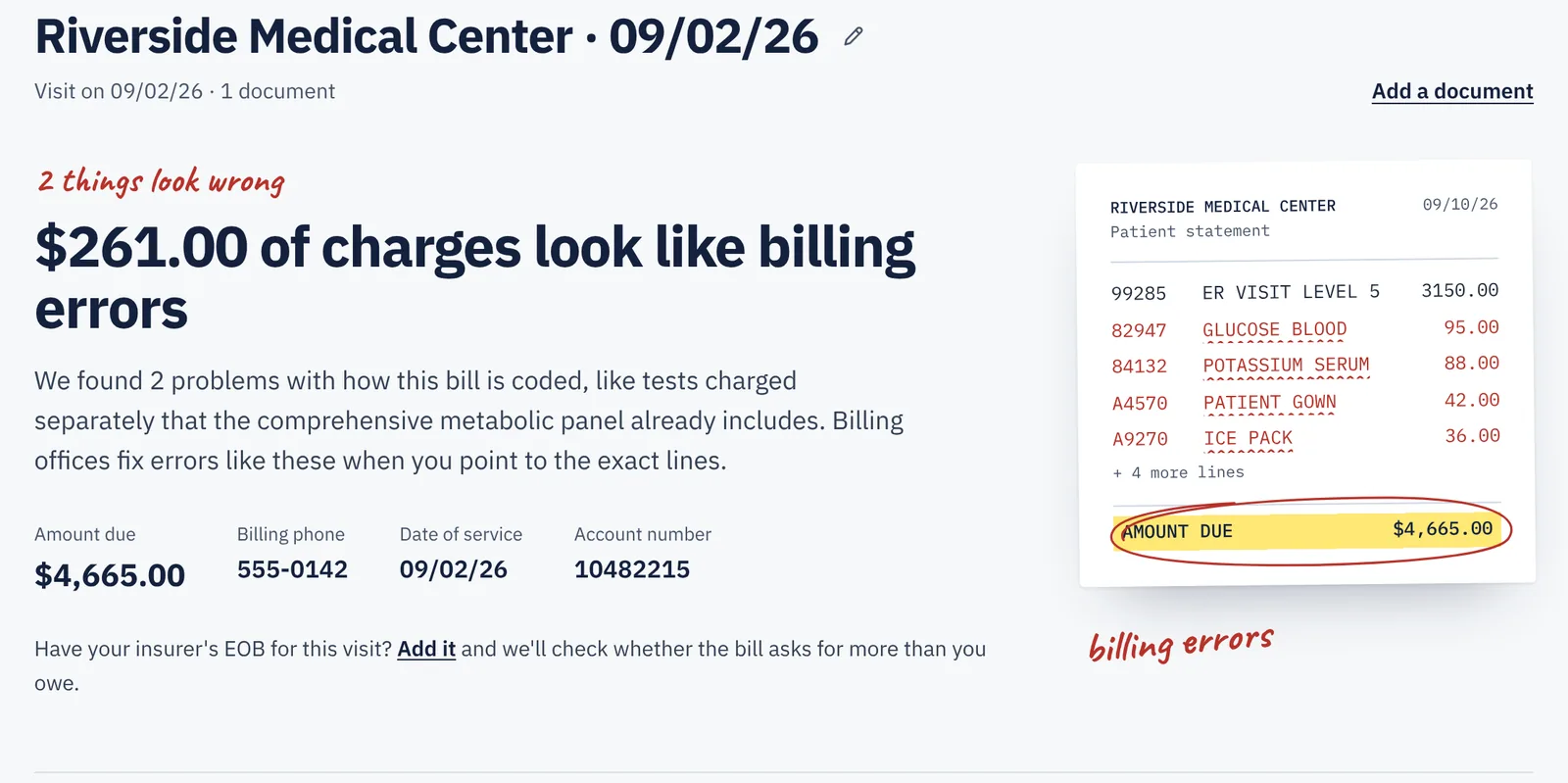
- Upcoding: a higher-level code than the care you got. For example, an ER visit billed as level 5 (code 99285, the most complex) when you were seen briefly for a minor problem, or an office visit billed as 99215 for a short follow-up.
- Unbundling: tests billed separately when they're part of a panel that's also on the bill. A comprehensive metabolic panel (80053) already includes glucose and potassium, so 82947 or 84132 on the same day is usually a double charge.
- Routine supplies billed separately: gowns, gloves, ice packs, tissues or an “admission kit” charged on top of the room or procedure they come with.
- Duplicate lines: the same code, date and amount listed twice. Sometimes it's two real doses or units; often it's a mistake.
- Facility fees: an extra charge when a clinic is owned by a hospital, even for an ordinary office visit. They're often allowed, but worth knowing about before you go back.
- List prices: the hospital's own “chargemaster” prices, often several times what insurers or Medicare pay. If you're paying without insurance, these are usually negotiable.
- Comprehensive metabolic panel (80053)
- $210.00
- Glucose (82947), already in the panel
- $65.00
- Potassium (84132), already in the panel
- $58.00
- Complete blood count (85025)
- $95.00
- Amount billed
- $428.00
- Without the double-billed tests
- $305.00
The glucose and potassium tests are part of the panel, so $123 is billed twice. (Fictional bill.)
How do you spot them on your bill?
- Ask for an itemized bill with billing codes (CPT or HCPCS) for every line. A summary bill hides all of this.
- Look for the same code on the same date more than once.
- Look for panels (codes 80047 to 80081) with separate tests on the same day.
- Check the ER or office visit level against what happened. A 15-minute visit for a sprain isn't usually the top level.
- Look for supply lines with vague names, and ask what each one was for.
- Compare prices with what Medicare pays for the same codes. If you're uninsured, that's a fair starting point for negotiating.
“I'm reviewing my itemized bill for account [number]. On [date] you billed code [code], and also [code] and [code], which are part of that panel. Please remove the duplicate charges and send me a corrected bill. Can you also hold the account while you review it?”
“I was billed a level [number] visit, code [code], on [date]. My visit was short and not complex. Can you have it reviewed against the medical record, and send me the documentation for that level?”
What if you have insurance?
Your insurer pays its own negotiated rate, not the list price, so list prices matter less. But upcoding and unbundling still raise what you pay toward your deductible or coinsurance. Compare the bill with your insurer's EOB: if the bill asks for more than the EOB says you owe, that's the first thing to fix.
Questions people ask
Is upcoding illegal?
Billing a higher level than the care supports isn't allowed, but most cases on a single bill are mistakes, not fraud. Ask for a review first. If you think it's deliberate and you're on Medicare or Medicaid, you can report it to that program.
Can I see a hospital's prices before I go?
Yes. Hospitals have to publish their prices, including a list of common services, under the federal price transparency rule. Search the hospital's name with “price transparency” or “patient estimate.”
Should I pay the bill while they review it?
Ask them to put the account on hold while they review the charges you questioned, and get the rep's name and a reference number. Pay any part you agree with if you'd like, but not the disputed lines.
What if they won't change anything?
Ask for a supervisor or the billing manager, and ask for the decision in writing. If you have insurance, ask your insurer to review the claim too. If you're uninsured, ask about financial assistance and a prompt-pay discount.
Not every repeated line or high-level code is wrong: some care really is complex, and some drugs are billed per dose. The goal is to ask about anything that doesn't match what happened. This guide is educational, not legal advice.
Educational information only, not legal, medical or financial advice. Rules vary by state and plan.